Part 1 - The visual impact of Nicaragua
To someone from the developed North, Nicaragua is an exotic and visually stunning country. Everyday I see something I’ve never seen before. For an artist, this is, of course, like being a kid in a candy store. I live in a good sized city and am bombarded by patterns, textures, colors, wonderful face in all shades of brown, some young and fresh others old and weathered, sexy bodies, some lithe and some voluptuous, churches, flowers of improbable form and color, animals wandering the streets, markets so busy it can take twenty minutes to go two blocks full of fruits and vegetables whose names and uses I have to ask about, religious and political icons, and scenes of high energy social interaction. All of this scrambles to find its way into my artwork. An overload of visual information comes at me as chaos. If I stand and look out my front door I see houses painted in combinations of the following colors: mustard, white, rose, pink, yellow, royal blue, orange, cream, baby blue, and chocolate. I also see dozens of patterns in decorative cement blocks, metal scroll work covering doors and windows, tiles on sidewalks and walls, and roofs made out of corrugated metal and ceramic tiles. Forget zoning regulations! The city is a jumble of decades upon decades of construction based on whatever the need for space is and whatever materials are at hand. The urban landscape presents everything from a 300 year old cathedral surrounded by a garden to a rubble strewn lot with just one graffiti covered brick wall left standing, a favorite spot for men to piss. None of this is static. Everything is in motion; taxis, bike taxis, motor cycles, cars, trucks, horse drawn carts, dogs, chickens, pickup baseball games, bicycles, people with baskets on their heads selling door to door, and kids running everywhere. And none of it is silent. There is a constant sound track of loud music, T.V.s going in every house and every door open to the street, hawkers calling out, church bells, car horns, shouts of greeting, laughing, roosters crowing, dogs barking, firecrackers, marching bands, and trucks and buses with bad mufflers rumbling by.
It sure ain’t Peace Dale, Rhode Island, in the US of A, where I live most the time, but I love it and feel stimulated to take it all in and see what kind of art I will make in this context.
Part 2 - Meeting other artists
I’m always interested in getting to know other artists. I’m fascinated by the universality of the impulse to make art and want to know the motivation and circumstances in which other people create. I’m also always looking for opportunities to collaborate in ways big and small.
Scene 1 - Ernesto Noguera
During our training Deb and I lived with separate host families in different towns. She was in Diriamaba, good sized town with an active cultural life and more than its share of lively graffiti. I lived in El Rosario a lovely little village. One time in Diriamba we were walking to our favorite coffee shop and we passed a young man with a portfolio under his arm. I went back and asked him if he was an artist. He said yes and we stepped inside a shop so he could show me some of his drawings. Ernesto is a handsome, friendly young man. He told me he had some paintings, too and we make plans to meet at a place called El Tortuga Verde, ( http://www.ecolodgecarazo.com/index_es.php ) a kind of garden/inn owned by a friend of his on the edge of town. When we met, I learned that the owner of El Tortuga Verde, Roberto Rappaccioli Lacayo, is a wealthy, old Nicaraguan hippy who partied with Mick and Bianca Jagger in the 70s. The best of the paintings that Ernesto showed me mix folk themes of Diriamba with stories from his personal past. In others you see a young artist playing around, trying to find a style. That’s as it should be, of course. I try to keep in touch with Ernesto. He is a young guy with a lot on his plate; wife, kid, art, music, scrapping together a living, etc. I hope to check in with him again before I leave Nicaragua, maybe go to one of his experimental jazz concerts. I’d also like to drink coffee again with Roberto at El Tortuga Verde and hear more of his stories.

Deb’s language teacher took her group on a field trip to meet Marlon and later we went back to his house and she introduced me. Marlon is a traditional mask maker, a musician, and a dancer. He is one of the organizers of the annual Festival of San Sebastian in Diriamba. Marlon lives with his extended family in a very humble house where they have produced dance masks and figures representing traditional dance characters for several generations. Marlon is a folklorist and cultural historian who can explain all the local traditions. His artwork is exquisite. We have three of his masks decorating our living room wall. I want everyone to know about his work because, for my money, he is one of the finest artists I’ve ever met in whatever form. I have the fantasy that before I leave Nicaragua, I’ll do an internship with him for a couple of weeks and learn to carve and paint masks.
Scene 3 - Eddis William Peralta
One of the attractions in Chinandega is the Bus Pelon, The Bald Bus. Every night this open air bus goes on tours of the city and it is always packed because it is a guaranteed way to catch a breeze. Walking to one of my schools not long after we arrived, I passed the garage where the bus parks. I struck up a conversation with a guy who was washing the bus. His name was Eddis and his family owns the bus. He lives in a couple of rooms next to the garage. There was an easel in his living room. I asked him if he was an artist and he said yes and showed me some of his paintings. He works mainly from magazine photos and combines different elements to make traditional Nicaraguan landscapes featuring thatched roof houses, horses, ox carts, fields, mountains and campesiños. I stop by and see him when I’m passing by. He is a lively, funny guy. He’s got a painting he wants to sell me and every time I’m at his house he asks me when I’m going to buy it. I still might. I think it would make a good souvenir of Chinandega.
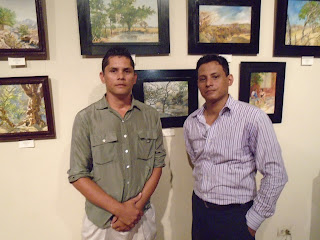

I do some work for Fundación Coen, a foundation that supports arts, health, and education here in Chinandega. They have a sizeable gallery in their office building and show local artists. Mario and Jaime are artists from Leon and I met them at the opening of their show at Fundación Coen.
These guys are the real deal. They are both very talented artists with great technique and vision. I’m in closer contact with Mario, because for the time being, Jamie has had to do other work to earn money. Mario is making a living as an artist. That is a tough thing to do anywhere in the world and it is really hard in a poor country. I think his success is in direct proportion to his talent.
I urge you to check out both artists’ work on their Facebook pages.
 |
That is Sergio on the right and his son Maycol is on the left.
|
Scene 5 - Sergio Jose Morales Briseño (https://www.facebook.com/sergiojose.moralesbriseno)
I have known Sergio for about a dozen years, really since he was a kid. I met him around 2003 when I came to Nicaragua to paint a mural in the courtyard at one of the schools sponsored by the Nicaraguan Resource Network. Even then, when he was still a teenager, Sergio was a talented artist and he was one of the most important contributors to the mural. He was also the hardest worker. Since then he has gone to art school and developed into a good painter and a very fine sculptor.
Deb and I recently visited him and his family in Managua. I hadn’t seen him since 2007. His young son that I had met then is now a teenager and Sergio and his wife have three more kids. This is a good time in his life. He told me the Sandinistas give a lot of support to artists and he has been given well paid commissions for public artworks. During our visit he was working on a memorial sculpture for a pet. His patron was a man who was in a position to send more opportunities his way. The finished sculpture, bigger than life size, in painted cement, is one of the best renderings of a dog I’ve ever seen.
Since the last time I saw him, Sergio has added a second floor to his family’s house. There are two bedrooms and an open balcony overlooking the compound where his wife’s family lives. This balcony is also Sergio’s studio. Hung on the back wall was a large (8’ x 3’) replication of Goya’s Naked Maja that he had done as a student in art school. That afternoon he gave me the painting. It is beautifully done and quite salacious! He said it had been hanging there for seven years waiting for me. I can’t tell you how touched I am by this gift!
Part 3 - Art and Politics in Nicaragua
I’ve had an interest for a long time in the murals painted in Nicaragua during the Sandinista era. There are at least two excellent books on this subject. One is The Murals of Revolutionary Nicaragua, 1979 - 1992 by David Kunzle and the other is Art and Revolution in Latin America, 1910 -1990 by David Craven. Especially, the Kunzle book does a great job of documenting the ways in which public art was an integral part of establishing a new national identity once Nicaragua overthrew the dictator and tried to emerge as an independent nation free of colonialism. The murals, many of which were made by international teams of artists in support of the revolution, represent a wonderful moment in time during which political revolution and cultural revolution walked hand in hand. Many are deeply optimistic and portray a new society where security, economic wellbeing, literacy, health, and education are advanced through the collaborative efforts of the people. They offer an egalitarian and socialist vision of what the new society could be. Of course, the United States fought an illegal proxy war to undermine these efforts. After a decade of killing and maiming tens of thousands, we forced and rigged elections that eventually removed the Sandinistas from the presidency 1990. To their credit, they abided by the election. However, they have never left the Nicaraguan political scene and were returned to power through the electoral process in 2006.
Just before being voted out of office in 1990, laws were passed to protect the murals. They were given the status of national treasures in hopes of preserving their historic and artistic significance. The United States has much to be ashamed of during this era, but one reprehensible action, that reverberates strongly with me as an artist, is that we conspired to have many of the murals, especially in Managua, destroyed. According to Kunzle, we went so far as having US companies donate paint to obliterate them. Many still exist and can be visited around the country, but many have been lost and only exist in old photographs.
Part 4 - The Art I’m Making
Simon’s Book - My grandson Simon made me a small book as a Christmas present. I have started drawing in it, using it as a kind of visual journal of living in Nicaragua. My plan is to fill it up and mail it back to him in hopes that he’ll replace it with another blank one.
Illustrations - I have done a number of illustrations to accompany health project materials. In doing these, I’m interested in drawing characters who resemble the people who will be using the materials. Since a lot of what we work on is sexual and reproductive health, I’m also interested in making sex look sexy rather than clinical.
I met a man named Victor Nissing who is a writer, cultural historian, and expert on the legends of Chinandega. I am working on a series of illustrations for one of his stories. He may turn them into a YouTube video of the legend.

Heroes and Icons - One of the interesting things about being an artist in Nicaragua is that there is a very well established iconography of national heroes. There must be a dozen portraits of historical and political figures, usually executed in a kind of visual short hand, that are instantly recognisable to everyone. For example, Sandino is almost always represented with a large cowboy hat shading part of his face, so any figure, whether elegantly rendered of crudely spray painted, wearing this hat is read as Sandino. Similarly, there is a standard pose for Ruben Darío in which his index finger rests on his cheek. If he is in this pose, it doesn’t have to be a great likeness to be identifiable as this great writer. I am doing my own versions of these icons. I’m not sure yet what they will become. I have had them embroidered on handmade Nicaraguan baseballs, but I’m saving that for a separate blog entry.

El Viejo - New Years Eve is celebrated, in part, by creating an effigy of the old year, El Viejo, stuffing it full of firecrackers and rockets and blowing it to kingdom come at midnight. This year I did the face for the one my neighbours were making, then got asked to do two more faces by other people in the neighbourhood. Next year I’m going to start early and make paper maché heads for these effigies. Since they will be hollow, they too can be filled with fireworks and will blow up, spectacularly, I hope, sending 2016 to its eternal rest and welcoming in 2017. Imagine the video!
In Nicaragua, everyone sells something. Deb and I are not part of the economic life of the community in this way, but I have the fantasy of making 10 to 15 of these heads and putting up a sign in our window that says, “Se Venden Cabezas del Viejo 100 cordobas!” (Heads for El Viejo for Sale!) I’ll set up a workshop and get the neighbourhood kids to help me make them! I should note that as a Peace Corps volunteer I am forbidden to do anything for profit, but by then I’ll only have six months to go in my service and I think it’ll be too late to kick me out. Besides turning a profit is highly unlikely.
Summary: These are my reflections on being an artist living in Nicaragua after being here a year. I have fifteen months to go. Stay tuned.


